Knowing how to effectively take notes can make or break you when it comes to school. In college, you will need to perfect multiple methods of taking notes. You will have to be able to take notes from lectures, notes from labs, notes from textbooks, and much more. Here is the ultimate guide to taking notes to help you get great grades with less stress! If you enjoy this post, you can find more study tips here!
Taking Notes From a Lecture
Taking notes in a lecture can be a double edged sword. Chances are, if you are writing down every single thin that your professor is saying, you are not going to retain any information. When you do this, your notes might not even make sense to you when you review them. What is going to help you retain and understand the lecture, is to engage and listen. It’s hard to listen when you’re writing! So, be sure that you’re only writing down key points!
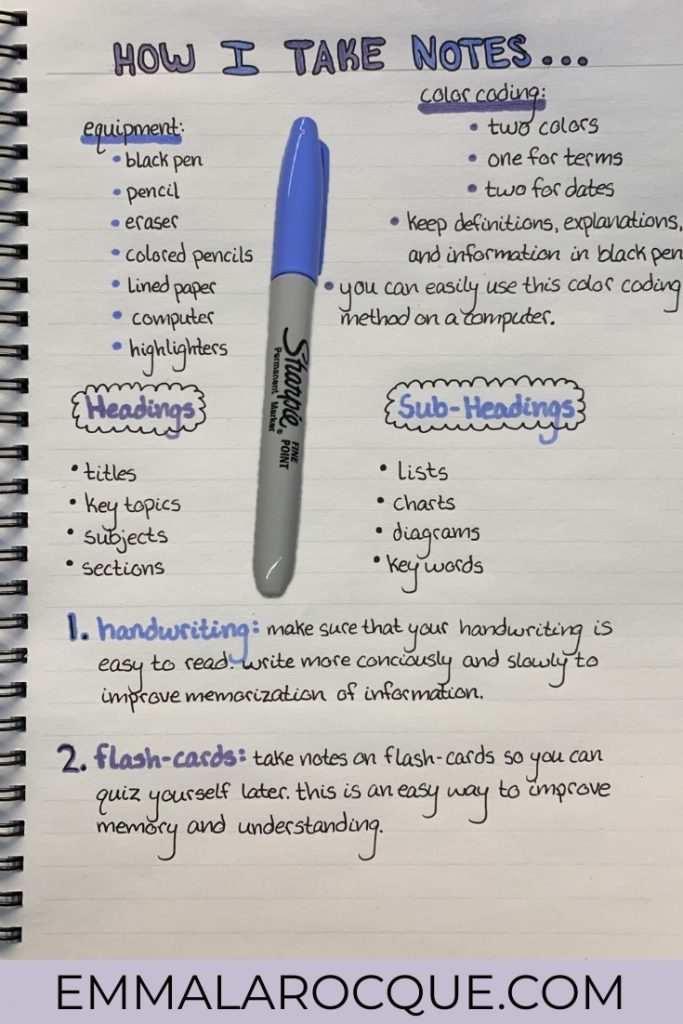
Handwriting
First of all, you’re definitely going to want to be able to read your notes. Also, when you put in the extra time to make sure you’re handwriting is good, you will have that extra time to retain and understand the information.
Colors
Using colors can be a great form of organization when it comes to taking notes! However, try to only use one or two extra colors at most. The more “busy” your notes are, the harder they will be to understand. You should also do your best to avoid doodling of to the side unless that is something that helps you focus.
Professor Notes
All professors are different; but in my experience, many professors will post their lectures online. This is a great way to refresh your memory and perfect your notes. Don’t use this as an excuse not to go to class!

Taking Notes From a Textbook
Reading a textbook can be so boring and tedious. From my experience, college professors assign professional level textbooks rather than college level textbooks. These can be extremely difficult to understand! Taking good notes is sometimes your only hope to understand the content of your textbooks.
Summarize
Before you even begin reading, look through the headings and sub-headings, end of chapter questions, and any charts and images. Also, be sure that you understand any bold or italicized keywords that appear throughout the reading.
Highlight
Read through the assigned pages once without stoping to take notes. As you’re doing this, highlight key points in your textbook to take notes on later. If you are finding the content difficult to understand, try reading out-loud or changing the position that you are sitting in. Such small things can greatly improve focus and understanding!
Re-Read
Read it again! As unfortunate as it is, sometimes the best thing you can do is read multiple times. After you re-read the text, go over your notes a few times too. I would recommend that you don’t try to finish an entire reading assignment in one sitting. You’re going to be better off taking breaks and coming back to it!
Outlines for a Paper
Creating an outline is a great way to begin to tackle a big writing assignment. I find that when I make an outline first, my writing process becomes much, much shorter. Outlining is a good organization tool to make sure that you are covering all important topics for your thesis. Outlines can also help with writers block!
Sections
Start your outline with headings and sub-headings for each section or paragraph. Your headings will be each large topic that you plan to cover and your sub-headings will be key points within your large topics.
Bulleted List
Underneath each sub-heading, create a bulleted list of some of the things that you plan to cover within each of these smaller topics. These can be a few words, or even a couple sentences. Depending on how seriously you take your outline, your essay can really begin to come together at this stage.
Citations
Personally, I prefer to include some research and citations in my outline. Again, doing this will just decrease your workload for later. Also, nothing is worse than putting information into your outline and then not being able to find your source when you’re ready to site it! It’s so much more efficient to do it all at once!

Class Notes
I find that it can be super helpful to have notebooks with ongoing notes for class. I like to have a notebook for each class that I take more generic notes in. This is separate from my notes on specific lectures and homework assignments. This helps with staying organized and knowing where to find specific notes when they’re needed!
Key Concepts
It’s a good practice to keep some notes on the key concepts that will be addressed in your class. You can often take these notes from the syllabus. Do some research ahead of time to see what your classes will be about. Trust me, your professors will be impressed when you’re the only one that will be able to answer their questions!
Definitions
Creating your own little dictionary of terms and definitions can be a super effective way of storing information. If you ever need to make flashcards or a quizlet to study for an exam, this reference will come in handy.
Do What Works For You
Everyone learns differently. Figure out what works for you and stick to that. The key is to be organized and thoughtful with your notes. There are so many ways to do that, and it may take some trial and error before you decide what is most effective for you!

Some Final Tips
Studies show that one of the most effective study methods is to rewrite notes. This has worked wonders for me!
Sometimes it’s so tempting to ask a classmate for their notes to copy; but it’s just not worth it! As much as it can suck to take the time to write quality notes, it will help you so much in the long run.
I hope that these tips are helpful! If you have any great note taking methods to share, let me know in the comments!






These tips are great! I struggle taking notes sometimes. I never know if what I’m writing down is actually essential or not lol, thank you for this post.
Thanks for the feedback! It’s always great to hear from other college students. 🙂
Great blog post. I’m definitely taking the advice you gave with me to university next year. 🙂
That was a really helpful read. Taking notes can be a challenge sometimes. At times in classes when I was in college If I was taking notes it felt like I was going to miss something the professor was saying. For me taking notes from textbooks was a lot easier. I wish I could have read this post while I was in school. This info is still applicable in the post school world of work and meetings.
I agree that textbooks can be easier. What is important vs. what is unimportant to write down can be a lot more clear. And it always helps that you can read at your own pace instead of listening to somebody lecture!
These are great tips. A lot of times I don’t even take notes. I listen more but I need to change that.
I did really good in college and I honestly really attributed to my note taking! Every time I use colors I would remember it so much better
I need to share this with my daughter. She is getting into some very advanced classes. Note taking could really help her.
Using different colors and highlighters are a great way to mark important notes! I like doing the same thing when I am writing in my planner.
Wow. It use to take me 2 hours two write notes for 10 text book pages. After awhile I just gave up. But now I can use these tips for the future
What a clever post! I definitely could have used these tips when I was in college. Notes are so important and I actually love taking them because they help me focus!
thanks for the tips. helps keep everything organize and easy to find
Wouldve loved to have these tips during uni!
I could have used these tips when I was in University. I find using color new in my notes for blog posts and other work is the most helpful as I am highly visual and learn, remember easier when I associate with a color.
Great post. As a former teacher. I know the importance of study skills and note taking. Teachers are so busy with covering the curriculum that they have no time to teach note taking which is a basic skill and can often make the difference between an average grade and an A+.
I am always taking down notes. Whether I’m just watching tv and see or hear something that I like, I’ll write them down. at the end of the day, my notebook will be filled with all sorts of things that I have written. These are great tips. Thanks for sharing
I remember those days when I was taking notes and actually I still do whenever I am in a meeting. I will share that post with my daughter, she is starting grad school this Spring.
I love using different highlights and underlining. Doodling also works for me.
Laaaaawd, I wish this article was around when I was in high school. This is beautifully written. I totally sucked at taking notes until about a year ago, and I feel like I’m still getting the hang of it!
Thanks for the positive feedback! Taking notes effectively is definitely a trial and error process. 🙂
I love taking notes but sometimes i find it hard to write neat and catch up to what are being said.
That’s a big problem for me as well!
You just reminded me about y sister in law. She has all the same routine with taking notes from school. These are really effective!
I love taking notes cause I think that’s how i learn! I find that i get to remember things more when i write it down.
I wish I could have read this couple year ago. I will save for my daughter in late future tho
Taking notes is a good way to document things. I usually do it on my phone and often use a voice recorder
These tips on how to take notes are great, especially for students who are learning for an exam. I remember using highlighters when I was studying, during uni.